
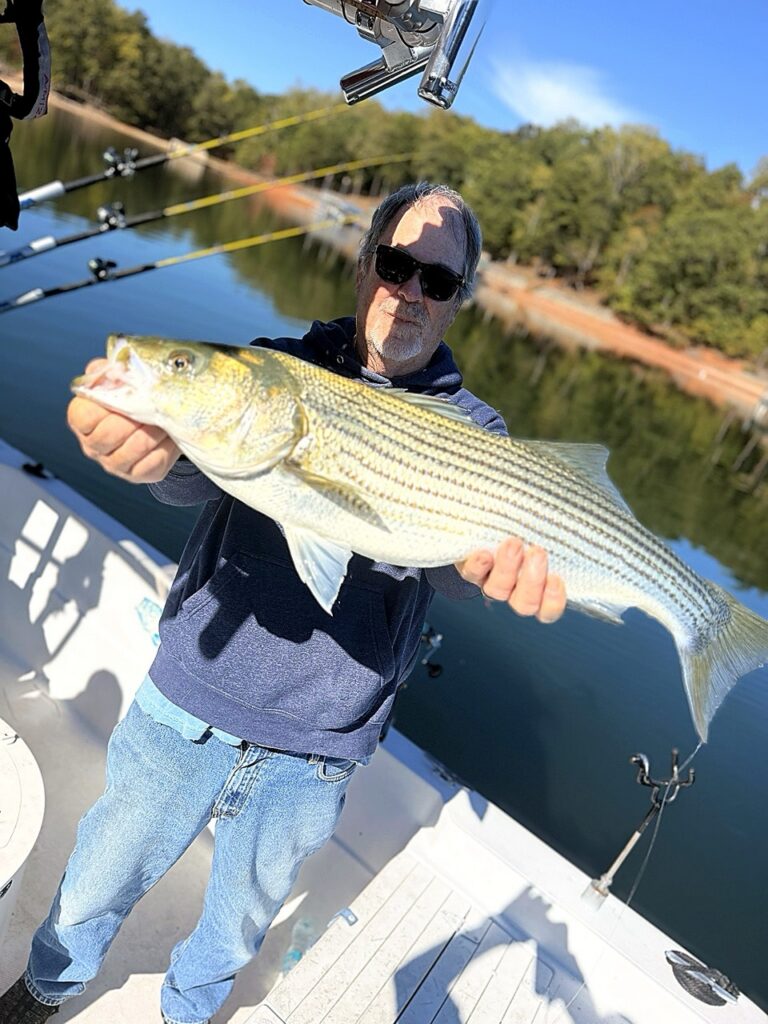
By Captain Matthew Haynes | Lake Lanier Striper Snipers
One of the biggest mistakes I see anglers make when targeting striped bass on Lake Lanier is using the wrong technique for the conditions they’re fishing.
Two of my favorite and most productive methods for catching stripers are down rods and planer boards. Both can be extremely effective, but understanding when to use each one can make the difference between struggling to get a bite and keeping your rods bent all day.
After years of guiding on Lake Lanier, I’ve learned that choosing between these two techniques really comes down to three things: how deep the fish are, how they’re positioned, and how much they’re moving around.
Let’s break it down.
When Should You Use Down Rods for Striper Fishing?
My general rule of thumb is pretty simple.
When I’m marking striped bass around 30 feet deep or deeper, I’m usually reaching for my down rods.
Down rods are one of the most effective ways to target fish holding in deeper water, especially when you’ve located a school that isn’t moving around very much.
One thing I’ve noticed over the years is that stripers holding in the upper 20–25 feet of the water column can sometimes be more aware of the boat passing overhead. I believe those fish can see or sense the boat more easily, which can make them a little more difficult to catch directly underneath it.
But once those fish get deeper, that becomes less of a concern.
The biggest advantage of down rods is precision. If I find a good school of stripers holding in 40, 50, 60, or even 70 feet of water, I can position my boat directly over them and present my live bait right in their strike zone.
However, there’s one important catch.
Down rods work best when you can locate the fish and stay on top of them.
If the fish are constantly moving around or scattered throughout a large area, keeping your baits in front of them becomes much more difficult.
Why Down Rods Work So Well During Summer on Lake Lanier
Summertime is a perfect example of when down rods really shine.
As Lake Lanier heats up, large numbers of striped bass concentrate in deeper water, especially toward the southern end of the lake near Buford Dam.
During this time, we can find some enormous schools of fish holding in relatively concentrated areas.
When that happens, down rods are hard to beat.
Instead of covering miles of water searching for individual fish, I can locate a school with my electronics, get positioned, and start dropping baits directly into the fish.
And this doesn’t just apply to summertime.
Anytime you find a large school of stripers holding in one particular location, down rods can be extremely effective.
For example, you might find stripers:
- Holding off the end of a main-lake point.
- Positioned on the backside of a point.
- Stacked along the edge of a hump.
- Feeding where wind and current are pushing baitfish into a specific area.
- Concentrated along a creek channel or underwater ledge.
When fish are holding in these locations for a reason, particularly when they’re ambushing baitfish, they may stay in that area long enough for you to work them effectively with down rods.
That’s when this technique really comes into its own.
When Should You Use Planer Boards for Striper Fishing?
Now let’s talk about one of my absolute favorite ways to catch striped bass: planer boards.
When I’m targeting stripers in the upper portion of the water column, especially fish holding shallower than 25–30 feet, planer boards are usually my preferred technique.
There are several reasons for that.
First, planer boards allow you to spread your baits away from the boat.
Instead of having all your fishing lines directly underneath or behind you, you can spread them out across a much wider area.
This is especially important when you’re dealing with fish that might be boat-shy.
Second, planer boards allow you to cover a tremendous amount of water.
Unlike down rods, where you generally need to stay directly over the fish, planer boards allow you to continuously search for feeding stripers while presenting multiple live baits.
Why Planer Boards Have the Advantage When Fish Are Scattered
Think about what happens during the fall transition on Lake Lanier.
During the summer, we might have thousands of fish concentrated in deeper water near the dam.
But as the water begins cooling and the fish start transitioning into their fall patterns, those schools begin breaking apart and spreading throughout the lake.
Instead of finding one giant school holding in 60 feet of water, you might find smaller groups of fish scattered throughout a creek, across a large bay, or along several points.
That’s when planer boards really start giving you an advantage.
I can spread multiple baits across a wide area and cover water until I find feeding fish.
And because those baits are running away from the boat, I’m able to present them to fish that might otherwise move away from a boat passing directly overhead.
If the fish are scattered and moving, I want planer boards. If they’re deep, concentrated, and holding in one area, I generally want down rods.
Of course, there are exceptions, but that’s the basic principle I follow.
Choosing the Right Planer Boards
There are some really good planer boards available today.
Captain Mack makes an excellent planer board, and they’re extremely popular with striper anglers. I actually used Captain Mack’s boards for years and had plenty of success with them.
But these days, I personally prefer using clear planer boards.
The biggest reason is their weight.
The large clear boards I use weigh approximately half an ounce, making them incredibly lightweight compared to many traditional boards.
When a striped bass grabs the bait, there’s very little additional resistance from the board.
And watching one of those boards suddenly take off across the water when a big striper crushes your bait is something that never gets old.
My Planer Board Rod Setup
I take planer board fishing pretty seriously.
Right now, I have approximately 14 rods dedicated to planer board fishing on my boat.
Eight of those rods are set up specifically for pulling larger gizzard shad.
The other six are designed for smaller live baits, including blueback herring and shiners.
Having different rods ready for different bait sizes allows me to quickly adjust my presentation based on what the fish are doing.
I’ve also continued having excellent success using Gamakatsu Big River Bait Hooks with my planer board setups.
They’re extremely sharp, strong, and dependable. When you’re targeting big striped bass, the last thing you want is a hook that bends out under pressure.
The Secret to Pulling Planer Boards: Speed Matters
Here’s something that I think a lot of anglers overlook.
Your trolling speed can make an enormous difference in how effectively your planer boards fish.
Personally, I like to move.
When I’m running a large spread of planer boards, I generally prefer pulling them around 1.0–1.2 mph.
There are a couple of reasons for that.
First, I find that my boards track much better at those speeds.
When you’re trying to run eight planer boards at once, keeping everything spread out and running straight is extremely important.
If you’re only moving around 0.6 mph, which is often a more suitable speed for pulling live blueback herring, your planer boards may not track as consistently.
That’s one of the reasons I don’t particularly like pulling herring behind planer boards.
Blueback herring are relatively fragile baits, and I simply prefer fishing faster than they’re generally comfortable being pulled.
Instead, I like using hardier baits such as:
- Gizzard shad
- Trout
- Shiners
These baits can handle the faster presentations I prefer, provided they’re healthy and appropriately sized.
Why I Love Pulling Gizzard Shad at 1.2 MPH
Now this is where things get interesting.
Sometimes those stripers absolutely love a fast-moving gizzard shad.
When I’m pulling gizzard shad around 1.2 mph, I’m often running the bait approximately 10 feet behind my planer board.
And there’s a reason for that.
Gizzard shad are notorious for being able to make quick, unpredictable movements. I call them their little ninja moves.
But when you’re steadily pulling those shad at 1.2 mph with a relatively short distance between the bait and board, you’re limiting how much freedom that bait has to dart around.
That can create a completely different presentation.
Instead of a baitfish swimming around freely, you’ve got a large meal moving steadily through the water.
And sometimes that triggers an incredible reaction bite.
I’ve had striped bass absolutely destroy those baits while we’re moving.
One second everything looks normal, and the next second that board takes off and the drag starts absolutely screaming.
That’s one of my favorite sounds in striper fishing.
When Slower Is Better: Targeting Trophy Stripers
Now, just because I love pulling planer boards fast doesn’t mean faster is always better.
There are certain situations where I’ll slow things way down, especially when I’m targeting really big striped bass.
Let’s say I know there’s a group of trophy stripers holding around a particular point.
Instead of covering a bunch of water with eight planer boards, I might put out just four really large gizzard shad.
And rather than pulling those baits at 1.2 mph, I might slow all the way down to 0.3–0.4 mph.
At those speeds, those big gizzard shad have much more freedom to swim naturally.
I’m basically allowing the bait to do most of the work.
Big striped bass don’t always want to chase down a fast-moving meal.
Sometimes those bigger fish are content to hold in a particular area and wait for an easy opportunity to feed.
By pulling those large gizzard shad extremely slowly, I can keep a big, natural-looking meal in front of those fish for a longer period of time.
Sometimes that’s exactly what it takes to convince a trophy striper to eat.
Down Rods vs. Planer Boards: Which Is Better?
The truth is, neither technique is always better. They’re simply tools for different situations.
| Fishing conditions | My preferred technique |
|---|---|
| Fish holding 30 feet deep or deeper | Down rods |
| Fish suspended in the upper 25 feet | Planer boards |
| Large schools concentrated in one area | Down rods |
| Scattered fish throughout creeks or bays | Planer boards |
| Deep summertime schools near Buford Dam | Down rods |
| Fish moving through a fall transition | Planer boards |
| Fish holding around a specific hump or point | Down rods if they’re deep and concentrated |
| Trophy fish holding around shallow structure | Slow-pulled planer boards with large bait |
The most important thing is learning to recognize what the stripers are doing and adjusting your presentation accordingly.
Don’t get so committed to one technique that you overlook what the fish are telling you.
The Best Bait Makes a Difference, Too
No matter which technique you’re using, your bait matters—a lot.
Whether I’m fishing down rods in 60 feet of water or pulling planer boards across a shallow point, I want the healthiest, liveliest bait I can get my hands on.
And when it comes to catching trophy stripers, sometimes you need trophy-sized bait.
If you’re looking for quality live bait and fishing supplies around Lake Lanier, make sure you check out Brookton Bait & Tackle.
Having good bait can make a tremendous difference in your success on the water.
Final Thoughts From Captain Striper Sniper
One thing I’ve learned from spending countless days chasing striped bass on Lake Lanier is that successful fishing is all about adapting.
A technique that absolutely crushed them yesterday might not be the right approach today.
The fish move. The bait moves. Water temperatures change. Seasonal patterns change.
And if you want to consistently catch striped bass, you’ve got to be willing to change with them.
For me, that means knowing when to get directly over a school of fish and drop down rods, and when to spread out the planer boards and start covering water.
And sometimes, it means slowing four giant gizzard shad down to a crawl and waiting for that one giant fish to make a mistake.
That’s what makes striper fishing so much fun.
Want to Learn These Techniques Firsthand?
I offer guided striper fishing trips on Lake Lanier, including instructional trips for anglers who want to improve their own fishing.
Whether you’re struggling to locate fish, trying to learn how to run multiple planer boards without getting tangled up, or wanting to understand how seasonal patterns affect striped bass, I’d be happy to help.
Captain Matthew Haynes
Lake Lanier Striper Snipers LLC
Come learn how to catch them, not just where to catch them!
Wow that was excellent
Its good to have specific details on when where and how
You covered very well
What lb test on your planer rods and what size leader?
Thankyou very much
Tight Lines and Bent rods to you
I use a 25lb main line, big game. And a 14lb fc sniper or 15lb seaguar fluro leader for small baits, and if I’m trophy fishing usually a 20lb leader.