
Lake Lanier Turnover: How It Affects Striper Fishing and the Fall Topwater Bite
By Captain Matthew Haynes | Lake Lanier Striper Snipers | October 8, 2026
Every fall, Lake Lanier goes through one of its most significant seasonal changes. Water temperatures begin dropping, the thermocline weakens, baitfish change their patterns, and striped bass start transitioning out of their summertime behavior.
You’ve probably heard fishermen talking about the lake “turning over.” Some blame turnover when the fishing gets tough. Others associate it with the beginning of the fall topwater bite.
But what actually happens when Lake Lanier turns over? Why does the thermocline disappear? And, most importantly, how can understanding these changes help you catch more stripers?
Let’s break it down.
What Is Lake Turnover?
To understand turnover, you first have to understand how Lake Lanier’s water is layered during the summer.
During the warmer months, the lake develops three primary layers.
1. Epilimnion — The Warm Surface Layer
This is the upper portion of the lake, where sunlight and air temperatures keep the water warm. It generally contains plenty of dissolved oxygen, but during the summer, temperatures can become uncomfortable or stressful for striped bass.
2. Metalimnion — The Thermocline
This is the transition zone where water temperatures drop rapidly as you move deeper.
For summertime striper fishing, this layer is extremely important. It often contains the combination of cooler temperatures and sufficient dissolved oxygen that stripers need to survive.
3. Hypolimnion — The Deep Water
Below the thermocline lies colder water that becomes increasingly isolated from the surface during summer.
Although this water may have temperatures that stripers prefer, much of it eventually becomes oxygen-depleted.
That’s an important distinction: Just because water is cold doesn’t mean it’s suitable for stripers.
By late summer, these conditions can squeeze stripers into a relatively narrow range of depths where both temperature and oxygen remain acceptable.
What Happens to the Thermocline During Fall?
As fall arrives and nighttime temperatures begin dropping, Lake Lanier starts losing the heat it accumulated throughout the summer.
The surface water cools, becomes denser, and starts mixing with the water underneath it.
Wind and changing weather conditions help accelerate that mixing.
As the upper mixed layer gets deeper, the thermocline gradually weakens and shifts deeper.
Eventually, the temperature difference separating the upper and lower portions of the lake becomes small enough that the water can mix throughout the water column.
When that happens, the lake has completed turnover.
According to Georgia’s Department of Natural Resources, complete turnover on Lake Lanier generally occurs around Christmas.
That’s right! Even though fishermen start talking about turnover in September and October, the actual process takes place over an extended period.
The fall fishing transition and complete lake turnover are two different stages of the same seasonal process.
And that’s where things get interesting for striper fishermen.
How Does Turnover Affect Striped Bass?
During the hottest part of summer, stripers are limited by two major environmental factors: water temperature and dissolved oxygen.
They need water cool enough to avoid excessive thermal stress, but they also need enough oxygen to survive.
That’s why you can graph fish suspended over extremely deep water without necessarily finding them anywhere near the bottom.
As the upper water column cools during fall, the amount of suitable habitat gradually expands.
Stripers that were previously concentrated within narrower depth ranges can begin exploring other portions of the lake.
This doesn’t mean every fish immediately runs shallow.
In fact, many stripers may remain deep for quite some time.
Some schools will stay around the main river channel, deep humps, timber edges, and underwater ledges, while others begin following bait into shallower areas.
This creates an interesting period when multiple fishing patterns can produce on the same day.
You might catch fish 60 feet deep in the morning and encounter another school actively feeding at the surface later that afternoon.
And yes, that brings us to one of my favorite parts of fall fishing.
How Does Fall Turnover Affect the Topwater Bite?
One of the most exciting sights on Lake Lanier is a massive school of stripers pushing blueback herring to the surface.
Water starts exploding, baitfish scatter in every direction, and suddenly you’ve got stripers feeding all around the boat.
But why does this happen more frequently during certain periods of fall?
The answer involves water temperature, dissolved oxygen, baitfish movement, and the feeding behavior of striped bass.
During summer, Lake Lanier’s surface water can become extremely warm.
A striper may briefly chase bait upward through warmer water, but spending extended periods near the surface can be stressful.
As fall approaches, the upper portion of the lake gradually cools.
That means stripers can begin chasing blueback herring into shallower water without encountering the same extreme temperatures they experienced during summer.
Meanwhile, baitfish schools are responding to their own changing environmental conditions.
When blueback herring move higher in the water column, stripers can follow.
And when a school of hungry stripers pushes those baitfish against the surface, the bait has nowhere else to escape vertically.
That’s when the water can erupt.
Does Turnover Automatically Trigger Topwater Feeding?
No, and this is something I think fishermen should understand.
Full lake turnover isn’t required for an outstanding topwater bite.
Topwater action can begin well before the thermocline completely disappears.
It’s the gradual cooling of the upper water column, combined with baitfish positioning and feeding opportunities, that makes these surface feeding events increasingly possible.
Some fish may remain 50 or 60 feet deep while others begin feeding near the surface.
And just because conditions become suitable for topwater activity doesn’t mean the stripers will feed on top all day.
Sometimes those fish will only surface for a few minutes before disappearing again.
Other times, you might experience repeated feeding activity throughout the morning or afternoon.
The key is understanding that surface activity is just one part of the fall transition.
What’s Happening on Lake Lanier Right Now? — October 2026
We’re currently in the early stages of the fall transition, and the fishing is beginning to reflect that.
On my recent guided trips, I’m still finding plenty of stripers holding deeper around humps, ledges, ditches, and open water near the river channel.
We’ve also encountered some absolutely enormous schools of fish.
However, just because you find a massive school doesn’t mean those fish are necessarily ready to eat.
On some trips, we’ve watched schools of stripers surround our baits without committing.
We’ve even found situations where fish holding around 40 feet were reluctant to bite, while fish positioned considerably deeper were more cooperative.
- Humps adjacent to the main river channel
- Deep-water ledges and channel swings
- Ditches running alongside underwater structure
- Timber edges near schools of baitfish
- Open water surrounding productive humps
At the same time, reports of topwater activity are beginning to appear around the lake.
That tells me we’re entering one of those transitional periods when anglers need to remain flexible.
The majority of the fish I’m locating haven’t made a major move shallow yet.
But that doesn’t mean the topwater bite can’t start developing in other areas.
Different portions of Lake Lanier can transition at different rates, and not every school responds to changing conditions the same way.
As temperatures continue falling, I’ll be watching closely for more baitfish moving higher in the water column and for larger schools of stripers beginning to feed near the surface.
How to Fish Lake Lanier During Fall Turnover
This is where understanding the science can really help you put more fish in the boat.
1. Don’t Abandon Deep Water Too Early
One of the biggest mistakes anglers can make is hearing reports of topwater activity and assuming all the stripers have moved shallow.
That simply isn’t the case.
During the early fall transition, I still spend plenty of time checking deep-water areas that have consistently produced fish.
Some of my favorite places to search include:
Pay attention to where the bait is positioned and whether the stripers are suspended above or relating directly to the structure.
Don’t get too attached to a particular depth.
The fish may move higher or lower throughout the day as conditions change.
2. Watch Your Electronics for Changes in Fish Depth
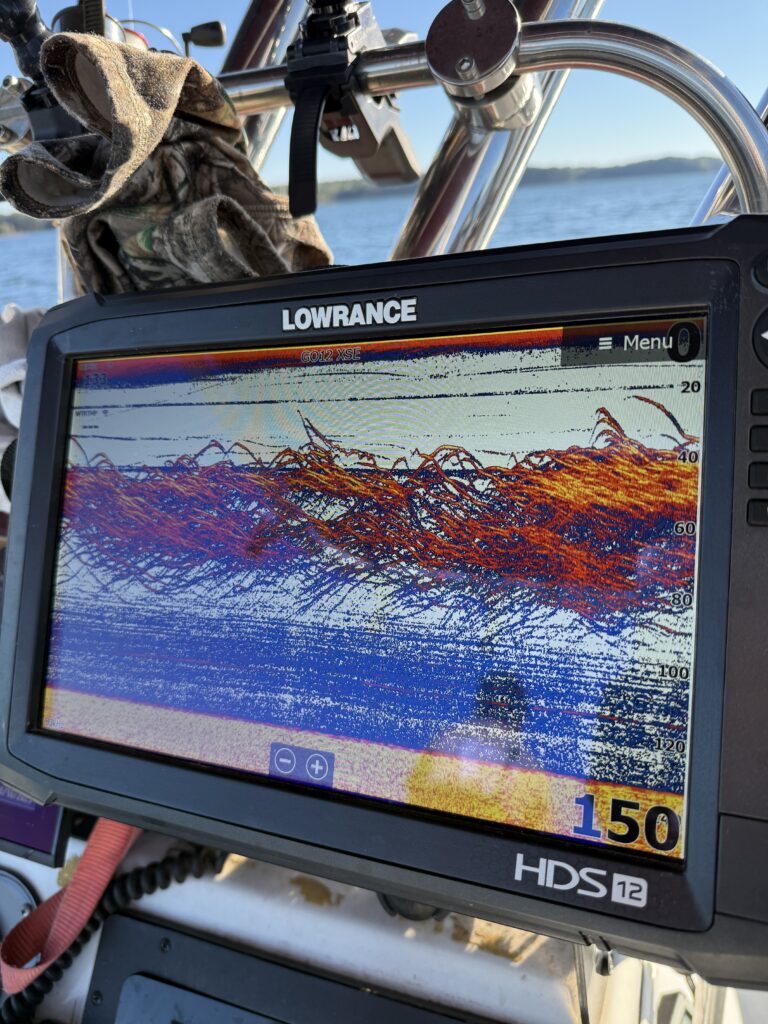
Your electronics can tell you a tremendous amount about what’s happening beneath the surface.
If you’ve been consistently marking stripers around 40–60 feet and suddenly begin finding significant numbers suspended in 20–30 feet, that’s worth paying attention to.
It may indicate that fish are taking advantage of improving conditions higher in the water column.
However, depth changes alone don’t prove turnover is occurring.
Wind, current, baitfish movement, sunlight, and feeding behavior can all influence where stripers position themselves.
The important thing is recognizing patterns instead of assuming the fish are going to be in the same location every day.
3. Keep a Topwater Rod Ready
This is one of my biggest recommendations for fall fishing.
Even if I’m targeting stripers in deep water, I want a rod rigged and ready to cast when fish suddenly come to the surface.
A school of feeding stripers might appear several hundred yards away and disappear before you can get another rod rigged.
For topwater fishing, I like having casting lures that can imitate fleeing blueback herring.
Walking baits, pencil-style topwaters, and other long-casting presentations can be effective when fish are actively feeding near the surface.
If the fish are busting bait but refuse to hit a topwater lure, don’t be afraid to try a subsurface presentation.
A swimbait, fluke-style bait, or other herring imitation worked just underneath the surface may trigger a bite when a floating lure won’t.
Remember: Just because stripers are breaking the surface doesn’t mean they’re going to hit every lure thrown at them.
Pay attention to the size of the baitfish and how the stripers are feeding.
4. Pay Attention to Wind and Baitfish
Wind can be your friend during the fall.
It can concentrate baitfish along windblown banks, points, and other structure.
Wind-driven surface currents can also influence where schools of blueback herring travel and how stripers position themselves to ambush them.
I like paying attention to areas where wind, structure, and baitfish activity come together.
However, not every windy bank is going to hold fish.
I still want to see signs of bait, striped bass, or feeding activity before spending too much time in an area.
And while birds can help locate feeding activity, remember that they aren’t always present when stripers are feeding.
Sometimes you’ve got to find the fish yourself.
5. Don’t Overlook Your Downlines and Live Bait
Topwater fishing gets a lot of attention because it’s exciting.
But some of the best fall fishing can still happen beneath the surface.
If I’m graphing a large school of stripers holding 40 or 50 feet down, I’m not going to ignore those fish just because I heard someone caught a few on top.
Live blueback herring presented at the correct depth can remain extremely effective throughout the fall transition.
Watch how fish react to your bait on the electronics.
If they’re following without committing, consider changing your presentation, adjusting your bait depth, or searching for another school.
Sometimes finding feeding fish is more productive than spending an hour trying to convince inactive fish to eat.
And if you’re fishing deeper water, always consider temperature and oxygen conditions for your live bait.
Healthy, lively bait is extremely important.
6. Understand How Water Movement Affects Feeding
Something else I pay close attention to on Lake Lanier is water movement associated with power generation.
When water is being released through Buford Dam, it can create current that influences baitfish and striped bass.
This can make certain areas more productive during particular feeding windows.
I’ve experienced days when fish were visible on the electronics for hours, but the bite improved noticeably once water movement increased.
That doesn’t mean generation will automatically turn the fish on every time.
But it’s another piece of the puzzle that can help explain why the same school might act completely differently from one hour to the next.
7. Be Prepared to Change Your Game Plan
Perhaps the most important advice I can give during the fall transition is to stay flexible.
Don’t assume that yesterday’s productive pattern will automatically work today.
You may start your morning targeting fish deep along the river channel and end your trip casting into a giant school of surface-feeding stripers.
Or you might spend the day catching fish on downlines while never seeing a single striper break the surface.
Both situations are completely normal.
The best approach is to let the fish tell you what they’re doing.
Does Turnover Make Lake Lanier Fishing Tougher?
It certainly can, but not necessarily for the reasons people assume.
During summer, temperature and dissolved oxygen can concentrate stripers into specific areas of the lake.
When those environmental restrictions gradually weaken, fish can spread out.
Instead of being concentrated in predictable locations, they may begin exploring different depths, creek arms, points, and open-water areas.
This can make locating schools more difficult.
Wind, weather fronts, changing water conditions, and inconsistent feeding windows can add to the challenge.
But here’s the flip side.
Once you begin identifying where the baitfish are moving and which schools are actively feeding, the fall transition can produce some incredible fishing.
The fish haven’t disappeared.
Their habitat is changing, and they’re adapting to it.
As fishermen, we’ve got to adapt right along with them.
When Is the Best Fall Topwater Fishing on Lake Lanier?
Historically, October and November can provide exciting opportunities for topwater striper fishing on Lake Lanier.
However, there’s no magic date when the bite suddenly begins.
Water temperatures, weather patterns, and baitfish movements change from year to year.
Some years, surface activity begins developing in late September.
Other years, the stronger and more consistent bite may arrive later.
The important thing isn’t what the calendar says.
It’s what the baitfish and stripers are doing on the water.
If you’re seeing blueback herring moving higher, scattered groups of stripers chasing bait, or occasional schools feeding on the surface, those can be early indicators of a developing topwater pattern.
And when conditions finally line up, the action can get absolutely crazy.
Final Thoughts From Captain Matthew
One of the things I love most about striper fishing is that there’s always something new to learn.
You can spend years on Lake Lanier and still encounter fish doing something completely unexpected.
Understanding turnover, the thermocline, and dissolved oxygen gives you a better foundation for understanding why fish behave the way they do.
But at the end of the day, you still have to get out there, locate the bait, read your electronics, and figure out what the stripers want.
Right now, I’m continuing to target deeper fish while keeping a close eye on the developing fall topwater bite.
As the water cools and more schools begin chasing blueback herring toward the surface, things could get exciting in a hurry.
And when those big stripers start blowing up on top, there’s not much that compares to watching a rod double over with a fish that just crushed your lure!
Want to experience Lake Lanier’s fall striper bite firsthand?
Whether we’re dropping live blueback herring into deep schools or casting into explosive topwater action, my goal is always the same: put you on fish and make memories you’ll never forget.
Book your Lake Lanier striper fishing trip with Captain Matthew Haynes at Lake Lanier Striper Snipers.
Tight lines, and I’ll see you on the water!
Captain Matthew Haynes
Lake Lanier Striper Snipers
Frequently Asked Questions
When does Lake Lanier turn over?
Lake Lanier begins its seasonal cooling and mixing during fall, but according to Georgia DNR, complete turnover generally occurs around Christmas.
Does turnover make stripers move shallow?
As the upper water cools, more habitat becomes suitable for stripers. Some fish follow bait into shallower water while others continue holding deep. Turnover doesn’t force every striper shallow at the same time.
Does turnover cause the fall topwater bite?
Not directly. Cooling water makes surface feeding more favorable, while baitfish position and feeding behavior determine when stripers actually come to the surface. Topwater action can begin long before complete turnover.
What is the best way to catch stripers during turnover?
Stay flexible. Target deep schools with live bait or vertical presentations, watch your electronics for changing fish depths, and keep a casting rod ready for surface-feeding fish.
Why do stripers sometimes stop biting during the fall?
Fish may become harder to locate as suitable habitat expands. Changing baitfish patterns, fishing pressure, weather, and water movement can also influence feeding activity. A difficult bite doesn’t necessarily mean turnover is the cause.